|
Sponsored By |
DOTEN-DUNTON
DESK
COMPANY |
|
|
|
||
|
Doten-Dunton Links History Page Clamps used by Doten-Dunton Desk Company
Interested in
|
This article was published in the May, 1949 issue of the NOFA Bulletin. "Profile of Kervin R. Dunton" Age 82 years, born on Isle of Westport, Maine (1867). Started manufacturing of desks and furniture as a boy. Became superintendent of the Derby Desk Company prior to organization of the Doten-Dunton Desk Co. in 1902. He has devoted his lifetime to the office furniture manufacturing business. His principal interests are his business and family (daughter and two granddaughters). In addition, his hobbies have always been hunting and fishing. Every fall he spends many days hunting and has been known to tire out many a younger man at this sport. He has always been a lover of good hunting dogs and has bred many champions. Member of National Office Furniture Assn., Boston Office Furniture Assn., Wood Office Furniture Assn., Life Member Boston Rotary, 32 Degree Mason and Life Member, Director of Mechanics Charitable Associates, founded by Paul Revere during the Revolutionary War. Spends each day, from early morning until closing time in tireless pursuit of running his two businesses, the Doten-Dunton Desk Co., and retail store, The Dunton Corporation. The Doten-Dunton Desk Co. did not become well known until after the Baltimore fire in 1908. The Baltimore & Ohio R.R. was putting up a new building and wished to purchase new furniture. Mr. Dunton went to Baltimore and took this up with the officials. It was then that what is know known as the sanitary base desk was developed. Previously all desks were full type pedestal construction built to floor and generally without casters. From that time on, Doten-Dunton desks were developed along sanitary lines. He attributes his good health to regular eating and working habits, exercise, and devotion to his work. He has lost known of his keenness and alertness and still has an abundance of energy. A Family Submitted History Mabel Derby's father started the Derby Desk Company in Boston in the late 1800s. She was married to Frederic Chauvin prior to 1900 and bore him two children, Doris and Joseph. Unfortunately, Fred was a "rolling stone" and left Mabel with the children. (Note: He later surfaced in New York and opened a company very similar to the Derby Desk Company) Kervin Dunton was the foreman of Derby Desk and, seeing the plight of Mabel and the children, stepped in with an offer of marriage. Mabel accepted. Mabel and Kervin later had a daughter, Margorie who married Harry Austin. When Mabel's father died, Kervin took over the management of the company and became partners with one Mr. Doten, changing the company name to Doten-Dunton Desk Company. The Doten-Dunton enterprise became quite successful. A History of the Doten-Dunton Desk Company In 1904, the factory was in Cambridge, with the offices at 64-66 Pearl Street in Boston. In 1932, their offices in Boston were at 32 Franklin Street. In 1943, their offices in Boston were at 91 Federal Street. The business was founded on an idea. In April 1902, Kevin R. Dunton, then occupying a prominent position with a large manufacturing concern, thought that many planned to produce as cheaply as possible and without regard to individuality of product. Mr. Dunton felt that many businessmen would prefer distinctive office furniture, and that he could develop a market. At its founding, the firm employed six cabinetmakers. At the outset, roll top, flat top, typewriter, and bookkeeper desks were the only items manufactured. Seventy percent of the product line was of oak, but by 1905, mahogany came into use and proved popular. The line expanded to include chairs. The firm became famous in 1908, as a result of the Baltimore fire. The Baltimore and Ohio Railroad erected a new building, and desired new furniture. Mr. Dunton conferred with the officials, and developed what is now called the sanitary base desk. Built on legs, these desks presented an improved appearance, and today (1930) this style is universally known and sought. Since 1914, walnut had become increasingly popular, and some 80 percent of the company product was made of that wood by 1930. In 1930, over 275 skilled workmen were employed in the Cambridge plant. The firm had its own retail organization in New England and dealers in all principal cities, here and abroad. Products were shipped to all parts of the world. Customers included banks, insurance companies, public service institutions, and executive offices of commercial concerns. Source: Excerpt from page 851, "History of Massachusetts Industries", published in 1930 in two volumes. [Note: Volume 1 presents the major industries in Massachusetts. Volume 2 presents biographies of the company leaders.]
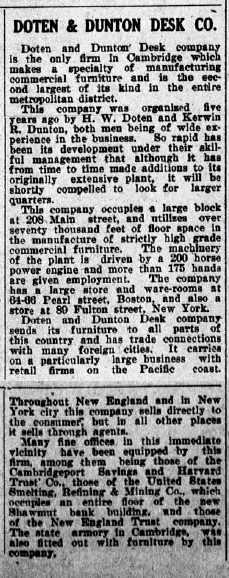
Doten and Dunton Desk company is the only firm in Cambridge which makes a specialty of manufacturing commercial furniture and is the second largest of its kind in the entire metropolitan district. This company was organized five years ago by H. W. Doten and Kerwin R. Dunton, both men being of wide experience in the business. So rapid has been its development under their skilful management that although it has from time to time made additions to its originally extensive plant, It will be shortly compelled to look for larger quarters. This company occupies a large block at 208 Main street, and utilizes over seventy thousand feet of floor space in the manufacture of strictly high grade commercial furniture. The machinery of the plant is driven by a 200 horse power engine and more than 175 hands are given employment. The company has a large store and ware-rooms at 64-66 Pearl street, Boston, and also a store at 89 Fulton street, New York. Doten and Dunton Desk company sends its furniture to all parts of this country and has trade connections with many foreign cities. It carries on a particularly large business with retail firms on the Pacific coast. Throughout New England and in New York city this company sells directly to the consumer; but in all other places it sells through agents. Many fine offices in this immediate vicinity have been equipped by this firm, among them being those of the Cambridgeport Savings and Harvard Trust Co., those of the United States Smelting, Refining & Mining Co., which occupies an entire floor of the new Shawmut bank building, and those of the New England Trust company. The state armory in Cambridge, was also fitted out with furniture by this company. Source: Cambridge Chronicle, July 27, 1907, page 15. |
|
|
|
||
|
||



 DOTEN
& DUNTON DESK CO.
DOTEN
& DUNTON DESK CO.